Keith Andrews — Tactics & tactical evolution
Keith Andrews
Brentford· Premier League ·  Republic of Ireland · Age 46
73/ 100
Solid
55th percentile of covered managers
Career snapshot
Age
46
13 SEP 1980
Appointed
27 JUN 2025
Tenure
1Y 3M
1 year, 3 months
Contractⓘ
Until Jun 2030
Contract confirmed
Senior managerial experienceⓘ
1 year, 3 months
Since 27 JUN 2025
In coaching
9 years, 9 months
Includes academy & assistant roles
Season: 2026/27Competition: Premier LeagueUpdated: Updated this weekSource: GafferLens editorial review
Tactical evolution
How Keith Andrews's football has changed across his managerial career.
Tactical evolution
How Keith Andrews's football has changed club by club. Move the slider backwards through the career — the tactical model and the simulation below change with it.
Brentford
2025 – Present · Head Coach · Premier League
Set-Piece Led • Direct • Second Balls
Nominal shape
4-2-3-1
First-phase build
Pivot drops to form a back three or a temporary single pivot
Settled possession
Narrow front players with late full-back width
High press
Structured pressing from goal-kicks and deep restarts
Mid-block
4-1-4-1 compact middle third
Low block
Back-five structures in specific matches
Alternative shapes
4-1-4-1 · Back five in selected games
These are different phases of football, not contradictions: a side can be nominally 4-3-3, build in a 2-3-5 and settle in a 3-2-5 within the same match.
Nominal shape
4-2-3-1
First-phase build
Pivot drops to form a back three or a temporary single pivot
Settled possession
Narrow front players with late full-back width
High press
Structured pressing from goal-kicks and deep restarts
Mid-block
4-1-4-1 compact middle third
Low block
Back-five structures in specific matches
Key strengths
- Counter-attacking output
- Middle-third compactness
- Set-piece structure
Key vulnerabilities
- Sustained possession against a deep block
Why this pattern?
BUILD Pivot drops beside CB → full-back advances
Pivot drop → full-back advance → front three narrow → vertical pass. · Brentford · evidence HIGH · 2025/26 season (complete)
BUILD Pivot splits the centre-backs
Both full-backs released by the split. · Brentford · evidence HIGH · 2025/26 season (complete)
ATTACK Forward drops → runner attacks the channel
The opposite-movement mechanism between dropping and running attackers. · Brentford · evidence HIGH · 2025/26 season (complete)
TRANSITION Middle-third regain → rapid forward pass
Brentford's primary scoring mechanism in 2025/26. · Brentford · evidence HIGH · 2025/26 season (complete)
PRESS Goal-kick pressing structure
Where Andrews does press high, and why. · Brentford · evidence HIGH · 2025/26 season (complete)
DEFEND Selective midfield jump from a compact block
The jump trigger from the middle third. · Brentford · evidence HIGH · 2025/26 season (complete)
Do not describe this side as a long-ball team: the direct play is structured and mixed with short build. High-turnover volume fell in 2025/26 while counter-attacking output rose.
Principles observed repeatedly across Keith Andrews's managerial spells, with the clubs the behaviour was actually observed at. Career evidence and current-club evidence are rated separately.
- Selective pressing aggressionHIGH
Observed · Brentford
Confidence · MEDIUM
- Middle-third compactnessVERY HIGH
Observed · Brentford
Confidence · MEDIUM
- Counter-attackingVERY HIGH
Observed · Brentford
Confidence · MEDIUM
- Vertical progressionVERY HIGH
Observed · Brentford
Confidence · MEDIUM
- Direct passingVERY HIGH
Observed · Brentford
Confidence · MEDIUM
- Tactical flexibilityHIGH
Observed · Brentford
Confidence · MEDIUM
Brentford is Andrews' first senior head-coach role. Earlier coaching work informs his development but is not displayed as a separate first-team tactical model.
- Build-up
- Flexible progression: Brentford build short but deliberately keep a strong direct option. A double-pivot midfielder drops alongside or between the centre-backs, creating a back three, a temporary single pivot and freedom for one or both full-backs to advance — the dropping pivot moves away from congested central pressure.
- Progression
- Structured direct play mixed with short build. Through balls and long vertical passes are a designed route, not a last resort.
- Attack
- Front players narrow around the centre-forward, with full-backs supplying width later. Opposite movements are central: a forward drops to drag a defender out and a second attacker attacks the vacated space.
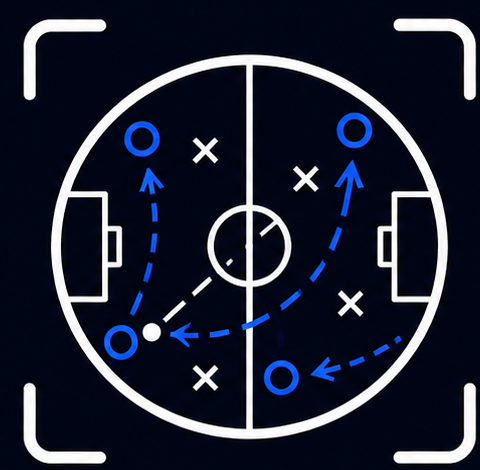
A full 11 v 11 structure built from this spell only. Illustrative of recurring principles, never a literal match replay.
Build-Up From Goal Kicks
Direct build-up targeting second balls and wide restarts
Sequence 1 of 4
11 v 11 · full match structure · all 22 players in frame
Step 1 of 4
Goalkeeper looks long first
Keith Andrews accepts a first-phase risk only when the reward is territory. The goalkeeper scans long before anything short: the front line is already set to attack the second ball.
Illustrative tactical pattern
Representative of Keith Andrews's tactical principles, not a literal replay of a match event. How Keith Andrews organises the first phase from 4-3-3: direct build-up targeting second balls and wide restarts.
Built from the Brentford tactical model held by GafferLens. Evidence basis: Brentford — current spell, evidence developing.
Brentford → Brentford
The verified record shows no material change in shape or principles between these two spells.
Spell start 27/06/2025 · Ongoing
News & analysis
Latest on Keith Andrews
Methodology & data freshness
GafferScore 0.4 (provisional editorial) · tactical model 0.3 (prototype model) · rankings updated 2026-08-17. Form window: Last 10 competitive matches, recency weighted.
Updated this week · Confidence LOW · Source: GafferLens editorial review
Image credits
Visual: GafferLens generic Brentford shirt — an original unbranded illustration using traditional club colours. No licensed photograph verified for Keith Andrews (status: PLACEHOLDER).