David Moyes — Tactics & tactical evolution
David Moyes
Everton· Premier League ·  Scotland · Age 63
78/ 100
Strong
78th percentile of covered managers
Career snapshot
Age
63
25 APR 1963
Appointed
11 JAN 2025
Tenure
1Y 9M
1 year, 9 months
Contractⓘ
Until Jun 2027
Contract confirmed
Senior managerial experienceⓘ
24 years, 11 months
Since 12 JAN 1998
In coaching
24 years, 11 months
Includes academy & assistant roles
Season: 2026/27Competition: Premier LeagueUpdated: Updated this weekSource: GafferLens editorial review
Tactical evolution
How David Moyes's football has changed across his managerial career.
Tactical evolution
How David Moyes's football has changed club by club. Move the slider backwards through the career — the tactical model and the simulation below change with it.
Everton
2025 – Present · Manager · Premier League
Pragmatic • Organised • Set-Piece Threat
Nominal shape
4-2-3-1
Mid-block
4-4-2 mid-block
Low block
4-5-1 low block against stronger opposition
Alternative shapes
4-3-3
These are different phases of football, not contradictions: a side can be nominally 4-3-3, build in a 2-3-5 and settle in a 3-2-5 within the same match.
Nominal shape
4-2-3-1
Mid-block
4-4-2 mid-block
Low block
4-5-1 low block against stronger opposition
Rest defence
Double pivot
Key strengths
- Defensive organisation
- Set pieces
Key vulnerabilities
- Sustained creation against deep blocks
Why this pattern?
DEFEND Organised block into wide recovery
The defensive foundation of the current Everton model. · Everton · evidence HIGH · 2025–present
Built from current Everton evidence — the West Ham simulation is not reused here.
Principles observed repeatedly across David Moyes's managerial spells, with the clubs the behaviour was actually observed at. Career evidence and current-club evidence are rated separately.
- Defensive organisationVERY HIGH
Observed · Everton 2002–13 · West Ham · Everton 2025–
Confidence · HIGH
- PragmatismVERY HIGH
Observed · Everton 2002–13 · Sunderland · West Ham
Confidence · HIGH
- Wide progressionHIGH
Observed · Everton 2002–13 · West Ham
Confidence · HIGH
- CrossingHIGH
Observed · Everton 2002–13 · West Ham
Confidence · HIGH
- Transition attackHIGH
Observed · West Ham
Confidence · HIGH
- Opponent-specific adaptationHIGH
Observed · West Ham · Everton 2025–
Confidence · HIGH
- Build-up
- Direct option retained alongside a short build; the choice is opponent-driven.
- Progression
- Wide progression into crossing positions.
- Attack
- Inside-moving wide players supported by advancing full-backs.
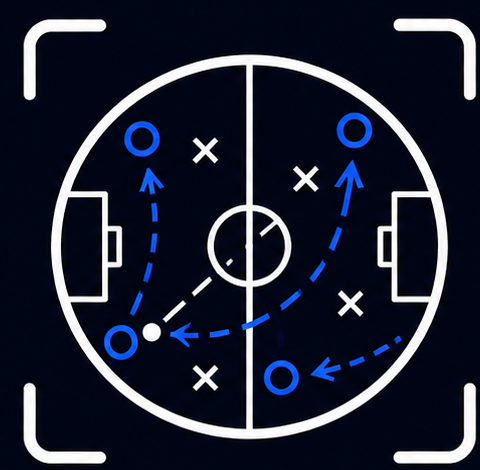
A full 11 v 11 structure built from this spell only. Illustrative of recurring principles, never a literal match replay.
Build-Up From Goal Kicks
Pragmatic build-up, direct when pressed
Sequence 1 of 4
11 v 11 · full match structure · all 22 players in frame
Step 1 of 4
Goalkeeper looks long first
David Moyes accepts a first-phase risk only when the reward is territory. The goalkeeper scans long before anything short: the front line is already set to attack the second ball.
Illustrative tactical pattern
Representative of David Moyes's tactical principles, not a literal replay of a match event. How David Moyes organises the first phase from 4-2-3-1: pragmatic build-up, direct when pressed.
Built from the Everton tactical model held by GafferLens. Evidence basis: Everton — current spell, evidence developing.
West Ham United → Everton
The verified record shows no material change in shape or principles between these two spells.
Spell start 11/01/2025 · Ongoing
Methodology & data freshness
GafferScore 0.4 (provisional editorial) · tactical model 0.3 (prototype model) · rankings updated 2026-08-17. Form window: Last 10 competitive matches, recency weighted.
Updated this week · Confidence HIGH · Source: GafferLens editorial review
Image credits
Visual: GafferLens generic Everton shirt — an original unbranded illustration using traditional club colours. No licensed photograph verified for David Moyes (status: PLACEHOLDER).